

Planning is done. Kickoffs are in full swing. Fiscal years are beginning. Many of us are wondering: How have our peers’ marketing investments changed in 2026?
Right now, we’re collecting data for the Marketing Budget Benchmark Survey, and I’m sharing some early signals from the data and my anecdotal insights while we await the statistically significant truth.
👉 Take the Marketing Budget Benchmark Survey here (<6 minutes, promise)
My 2026 Budget Predictions
As mentioned, the full data isn’t in yet, but based on dozens of conversations with my clients, CMO friends, and my CMO AI clubs, I’m seeing several patterns emerging.
📉 1. Marketing Budgets Are Down as a % of Revenue
For many B2B companies, marketing spend as a percentage of revenue is down several points year over year.
The familiar mandate, “do more with less,” has finally become operational:
AI is expected to deliver real productivity gains
CFOs are prizing efficient growth
Growth expectations remain high, even as budget ratios compress
The budget didn’t disappear; the tolerance for inefficiency did.
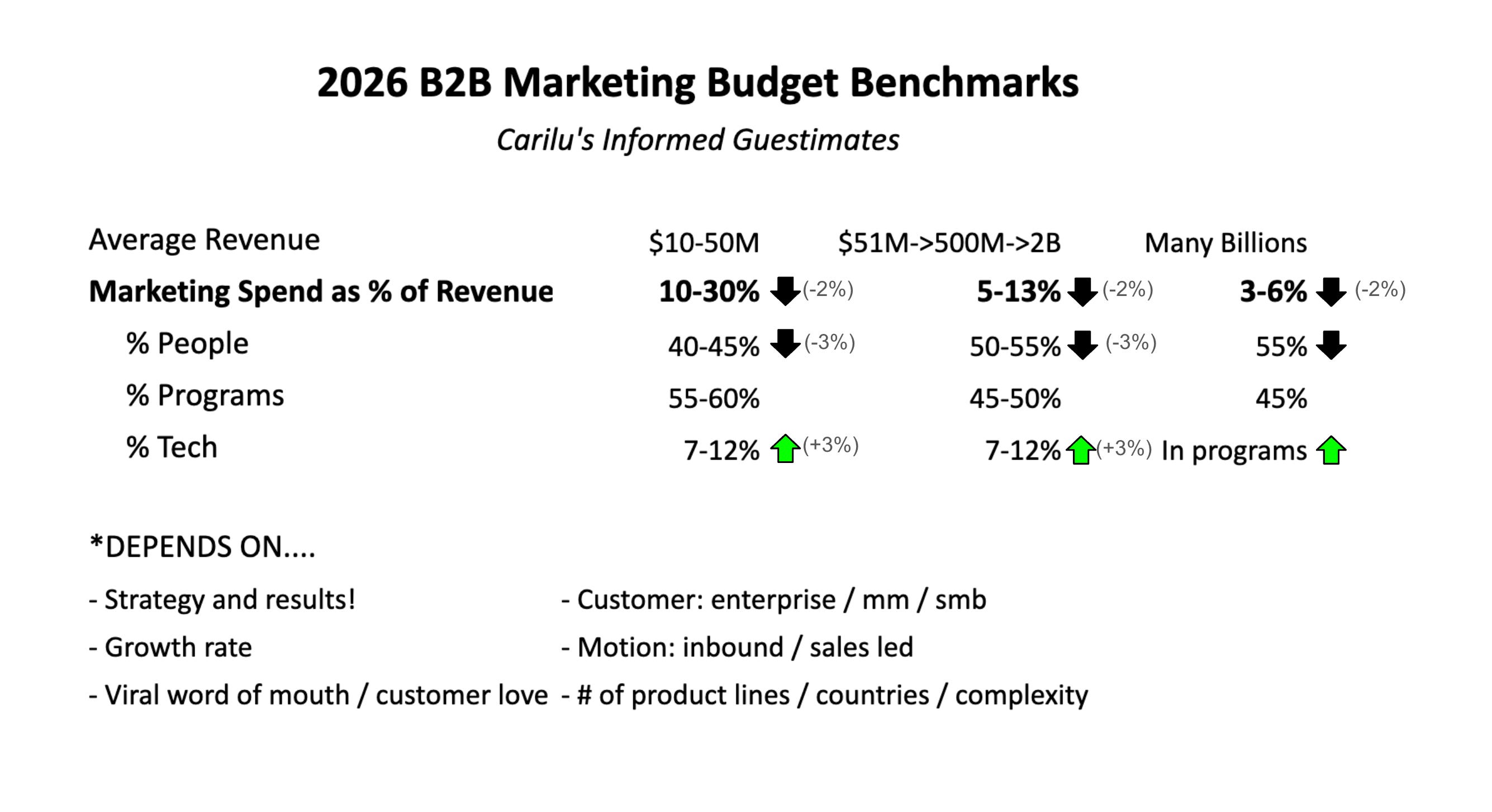
2. Marketing Tech Budgets Are Up Meaningfully
AI is no longer a pilot line item. As companies move from experimentation → production, tech spend is climbing fast:
AI tools
Data infrastructure
Inference costs
Orchestration layers
Internal GPTs and automation stacks
Early survey data shows tech budgets up 2–3% year over year.
That’s a huge shift when you consider that:
10% has historically been a “normal” martech allocation
A 2–3% swing represents a major rebalancing, not a rounding error
AI isn’t free. And it’s no longer optional.
3. Headcount Isn’t Being Cut, It’s Being Frozen
For most established companies, the tech budget increase isn’t coming from layoffs. Instead:
CMOs are slowing hiring
Teams are holding steady while expectations rise
In other words:
Headcount budgets are being reallocated, not slashed.
Teams are expected to:
Produce more pipeline
Support more products
Serve more segments …with roughly the same number of humans.
2026 is the year CMOs are expected to prove AI’s revenue contribution, not just its productivity story. No pressure.
A Tale of Two Cities: AI-Native vs. SaaS
One of the most interesting splits I’m seeing:
🚀 AI-Native Companies
Often in hypergrowth
Heavy investment in brand, experience, and hiring
Surprisingly less obsession with AI efficiency internally
Hiring like crazy as they build companies from scratch and add new skills
Why?
Many AI-native companies already benefit from:
New budgets for AI products from buyers
Massive inbound demand
Viral word-of-mouth
Their existential challenge isn’t efficiency, it’s standing out in noisy, fast-moving markets. They may have smaller marketing teams - because their revenue is growing even faster than hiring.
Traditional SaaS (Adding AI)
This group has it harder. They’re:
Protecting an existing revenue base
Replatforming products with AI
Re-educating the market
Doing all of it with tighter budgets
These teams are leaning hard into AI for efficiency, because they have to. They’re trying to fund the future without starving the present, a difficult balancing act. Their customers’ budgets for new SaaS investments might be frozen, as they await the impact of vibe coding and agent-building transformation. Every % of revenue growth is hard-earned.
Why This Survey Matters (We Need You)
Budget trade-offs have real implications for a team’s success. And anecdotes only get us so far. If you want:
Real benchmarks
Stage-specific comparisons
Insight into how your budget stacks up
Clarity on where peers are investing (and cutting)
…we need volume.
👉 Please take the Marketing Budget Benchmark Survey now
It takes under 6 minutes, and the output will synthesize hundreds of 2026 marketing budgets across stages, segments, and motions, giving you real leverage in planning, board conversations, and prioritization.
With Gratitude
Huge thanks to Ray Rike and the BenchmarkIt team for orchestrating this effort, and to Jon Miller for collaborating.
I’ve long admired BenchmarkIt’s approach to market research. If you’re looking to add credible data into marketing, they’re worth a serious look.
Carilu Dietrich is a former CMO, most notably the head of marketing who took Atlassian public. She currently advises CEOs and CMOs of high-growth tech companies. Carilu helps leaders operationalize the chaos of scale, see around corners, and improve marketing and company performance.
Just validating that's what I'm experiencing too in my world
Always a valuable read for GTM insights. I feel so sorry for folks in traditional SaaS right now. The ground has shifted beneath their feet and it’s not their fault. The category is the most exposed to the AI paradigm shift and their previous success has made them too large to pivot quickly enough to adapt. Lots of consolidation coming and PE is waiting. Those with good hard skills will transition to the new AI native paradigm, but it’s going to be messy and painful in the middle.