

The AI work that started as a side hustle is now becoming a dedicated function. The job descriptions are revealing the patterns. I’ve been collecting those JDs and trading notes with AI-native and traditional SaaS CMOs. Here’s what I’ve found.
Three Archetypes Are Emerging Inside Marketing
Archetype 1: The GTM Engineer (Marketing AI and Automation Lead, Mktg Engineer)
This is a developer/builder. Often technical in background, they frequently come out of web development, marketing technology, or revenue operations. This person actually builds the agents, automations, and integrations that the subject matter experts and strategy folks design. But they also know marketing flows and systems inside out.
Toast recently posted a role titled “GTM Engineer, Marketing Operations AI Innovation” that captures this archetype well. The mandate: be embedded directly with marketing teams, building AI-powered agents, automations, and workflows that permanently transform how marketers execute. Specific responsibilities include designing and deploying custom AI agents, integrating AI APIs and MCP servers, building evaluation frameworks to measure agent quality, and coaching marketers. Required experience includes growth marketing plus hands-on work with agent frameworks and marketing tools.
→ See the full Toast GTM Engineer Job Description (Or here if it’s taken down)
Stripe looks like it’s building an entire GTM Engineer Army:
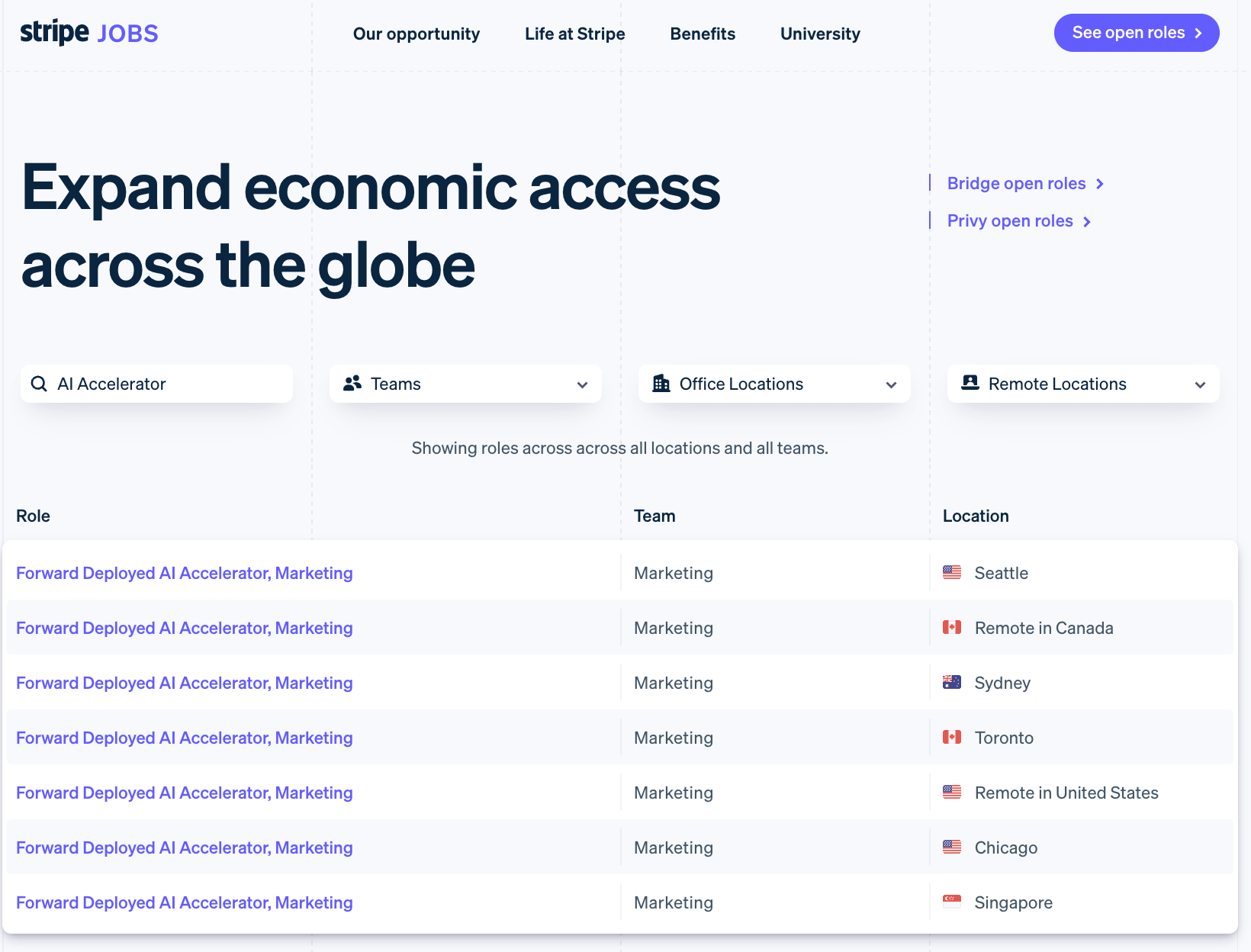
→ See the full job description here.
This role is growing quickly: LinkedIn listed over 3,000 open GTM Engineer positions in January 2026, up from around 1,400 six months ago. They are in hot demand and often require sizeable salaries.
Archetype 2: The Marketing AI Center of Excellence Lead (Head of Marketing AI, Senior Director of AI Projects)
This role is less about execution and more about enablement at scale within marketing. It leads the internal function that sets standards, runs pilots, tracks what’s working, and spreads best practices across a large marketing organization. It’s an internal consulting arm for AI adoption, sitting inside marketing.
These are appearing primarily in enterprise marketing teams, companies with 20+ person functions where you need someone to coordinate so you don’t have 15 different teams running 15 different experiments with no shared learning.
Who you’re looking for: A senior program or project leader with real marketing depth. Someone who has run complex cross-functional initiatives, is a natural educator and communicator, and has enough technical literacy to evaluate tools without necessarily being a builder themselves. Often, this is a growth role for existing people on the team who are good at navigating the organization, plus innovative and hungry.
Some enterprises have AI enablement roles inside individual teams. Sprout Social’s CMO, Scott Morris, recently promoted a long-time web developer into a “Senior AI and Creative Technology Strategist” role, reporting to Creative Operations. Their mandate is to evaluate and implement AI tools specifically for designers, animators, writers, and developers, and coach each discipline through adoption.
What makes this role distinct is the people challenge as much as the technical one. The JD explicitly calls out the need to anticipate emotional responses to change, including fear of replacement, and to navigate creative team dynamics without direct management authority. That’s a very different skill set than the cross-functional CoE that’s running pilots and tracking metrics across all of marketing. You could see this role emerging within in demand gen or product marketing as well.
→ See the full Sprout Social Senior AI & Creative Technology Strategist job description
Archetype 3: The VP of Marketing Excellence and Transformation (Also called: VP of Marketing AI, Head of Marketing Operations and AI)
This is the senior marketing leadership role that anchors the whole AI marketing function. CrowdStrike recently made this hire, titling it “Vice President, Marketing Excellence and Transformation,” a direct report to the CMO. A few things that stand out from their job description:
Responsible for defining the AI use case roadmap across marketing
Owns governance, legal/compliance coordination, and vendor evaluation
Leads cross-functional working groups with sales, IT, and legal
Serves as executive sponsor for AI transformation within marketing
Builds and manages a small internal team of specialists
That last point is key: at enterprise scale, this person might have the GTM Engineer and the CoE Lead reporting into them. They’re not doing the building or the enablement themselves. They’re owning the transformation mandate and creating the conditions for both to happen. (At large-scale companies, the GTM Engineer could also sit within centralized AI Engineering as well)
One other striking line from the CrowdStrike JD: “Prior CMO experience is a plus.” That tells you how senior and strategic this role really is.
Who you’re looking for: A senior marketing leader comfortable with ambiguity, with a strong process and systems brain, who can operate across organizational boundaries. They don’t need to write code. They need to know what’s possible and drive transformation across a complex organization.
→ See the full CrowdStrike Vice President, Marketing Excellence & Transformation job description
Marketing’s Best Friend - The AI Enablement Engineer
The next role might not report to the CMO. But it will be among marketing’s to collaborators.
The AI Enablement Engineer
The AI Enablement Engineer is a deeply technical function, typically living in engineering or IT, whose job is to build the agent infrastructure for the whole company. Think MCP server integrations connecting AI agents to internal tools, context engineering across systems and knowledge bases, and special-purpose agents built for specific functions like data analysis or legal review. The common thread is ungating multipliers for others, making AI genuinely work for people who wouldn’t otherwise get value.
Critically, this person also owns the guardrails. As agents get access to more systems, more data, and have more ability to take action, someone has to define what they can touch, what they can output, and who can see what. The AI Enablement Engineer works closely with security, legal, and IT to establish data access rights for agents, ensure sensitive data isn’t exposed through outputs, and set the boundaries that allow the rest of the company to build and experiment with confidence. This is increasingly one of the most important parts of the role. Agents without proper access controls aren’t just a trust risk, but could be an existential business risk if something goes really wrong.
For marketing teams, this person is the difference between running lightweight automations and having access to a real technical foundation built on guardrails you can trust.
You might be wondering how this differs from the GTM Engineer. In theory, the GTM Engineer is marketing-native and focused on GTM use cases, while the AI Enablement Engineer is an engineering function serving the whole company at a deeper infrastructure level. In practice, at smaller companies these roles often collapse into one person, someone technically minded who handles whatever needs handling, whether that’s a marketing automation or a company-wide agent framework. The distinction becomes most meaningful at enterprise scale, where marketing is often a customer of a separate engineering function.
→ Maxime Beauchemin (creator of Apache Airflow and Apache Superset) wrote the definitive piece on this role last week. Worth a read!
What This Looks Like at Different Company Sizes
At a large enterprise (30+ person marketing team): You’re building dedicated functions. A VP of Marketing Excellence and Transformation anchoring the function, one or two GTM engineers, and a CoE Lead driving internal enablement. The coordination overhead is real and someone needs to own it. Samsara’s CMO, Meagen Eisenberg is one of the better examples I’ve seen of this done well. She’s built a substantial in-house GTM engineering team (10+) within marketing, doing incredibly sophisticated work. She recently joined the Future of Marketing Podcast here.
At a mid-market company (10 to 20 person marketing team): You probably can’t justify fully dedicated AI roles yet. Identify your existing ops leader and give them an explicit AI mandate. Find your one or two most technically inclined people and give them room to build. Run pilots with structure so the learning is shared.
At a lean, high-growth startup (3 to 8 person marketing team): The playbook here is less about roles and more about hiring profile. Prioritize generalists who are already using AI tools fluently. A PMM or demand gen marketer who can build their own automations and generate assets at quality is doing the work of two specialists right now.
The Through-Line
Across all of these patterns, a few things stay consistent.
You need navigators: people who can move across organizational boundaries, align with IT and legal, and translate between what marketing needs and what’s technically possible. Program management skills married to real marketing depth.
You need builders: people who can actually construct the workflows, agents, and integrations, even if that’s primarily no-code.
And you need subject matter experts who are AI-fluent: your best demand gen leaders, your best PMMs, your best content strategists. If they’re using AI well, they’re going to be dramatically more productive. If they’re not, they’ll be increasingly outpaced by people who are.
The org chart isn’t being torn up. It’s being reconfigured. The CMOs who understand the new configuration will have a meaningful advantage.
→ Have you seen job descriptions for new AI roles in marketing? I’m building a library and would love yours. Drop it in the comments or send it my way.
Carilu Dietrich is a former CMO, most notably the head of marketing who took Atlassian public. She currently advises CEOs and CMOs of high-growth tech companies. Carilu helps leaders operationalize the chaos of scale, see around corners, and improve marketing and company performance.
We just hired our first VP GTM Engineering. What’s the JD ? Automate everything that can be automated 😅