

Sometimes marketing has to be reactive:
An urgent sales request comes in for the biggest deal of the quarter…
The CEO has a brilliant campaign idea...
A competitor launches something new that must be addressed…
The content roadmap can shift (reasonably) all the time. But in the long term, it pays to have a strategic roadmap to prioritize which content will have the biggest impact and to be sure you have full coverage instead of a random assortment of content.
Last week, I wrote about how market maturity should shape your content strategy. But strategy alone isn’t enough. You need a system.
I begged Shannon Pragger, a marketer and advisor I admire, to share the planning templates she’s used to help me and many others create a high-impact content roadmap. She said yes! You can download the full set of content templates here, and she can help you if you want to work together.
Pre-Work: Start With Buyer Questions, Not Content Ideas
Let’s assume you’ve already identified the key personas in your buying committee. Before mapping content, you need to map the questions the buyers are trying to answer at each stage of their journey. Not generic questions. Here’s an excerpt from a content strategy of a wealth management firm - notice the specificity of questions to the stage and product:

When you map persona × stage × question first, content planning becomes much sharper.
Today, AI can dramatically accelerate, or do this step for you. I often use prompts to pressure-test persona assumptions, asking AI to simulate how a CFO, technical buyer, or end user might evaluate our product at each stage. It’s not perfect, but it quickly surfaces blind spots and question gaps we might miss on our own.
Here’s the template:

Step 2: Audit What You Already Have
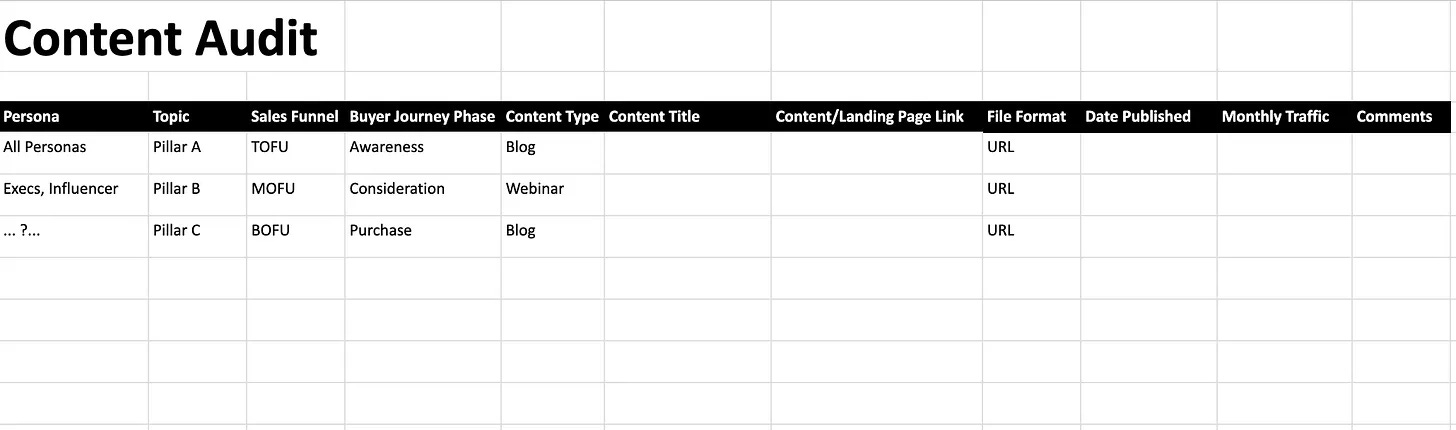
Most marketing teams have vast troves of content, but little understanding of how their coverage is across personas and stages of the buying funnel. A simple audit helps wrangle the chaos and start to systematically assess how effective the whole corpus of content is. A simple audit should capture:
Persona
Funnel stage
Topic / pillar
Content type
Performance (traffic, engagement, pipeline influence)
Gaps
The goal isn’t just inventory.
It’s clarity:
Where are we overweight?
Where are we thin?
What’s performing?
What’s noise?
AI makes audits faster, too. You can upload your content corpus and ask AI to classify assets by persona, funnel stage, and topic cluster. It won’t be flawless, but it can give you an 80% first pass in minutes, something that used to take weeks.
Step 3: Map Content by Persona and Stage
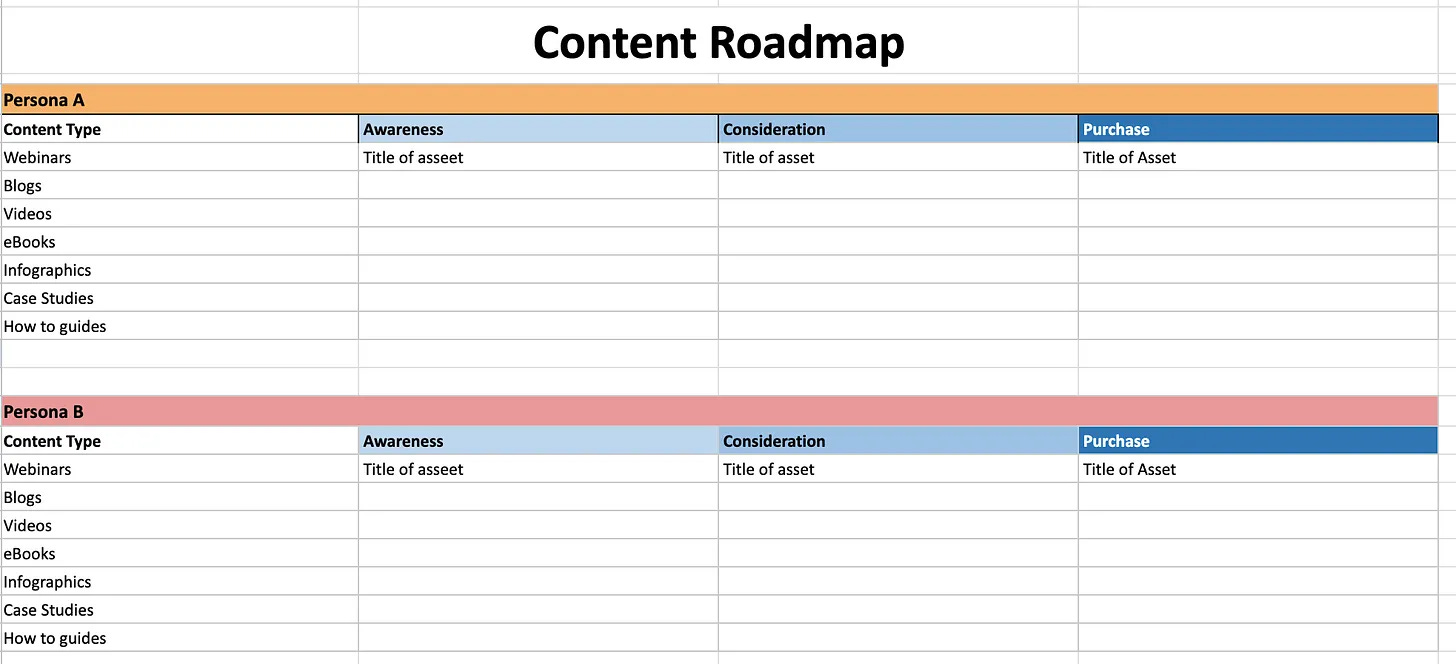
Now we move from audit to architecture. Using the persona question work and the audit, map:
Persona
Buying stage
Content type
Asset title or idea
This is where you identify:
Missing awareness content for technical buyers
Weak consideration assets for champions
Thin decision-stage proof
You’re building a matrix that shows not just what you have, but what’s needed.
Once gaps are visible, AI can help generate structured outlines aligned to specific persona questions. Instead of starting from a blank page, you’re starting from a mapped need, and asking AI to build within that constraint.
Step 4: Turn Strategy Into a Managed Plan
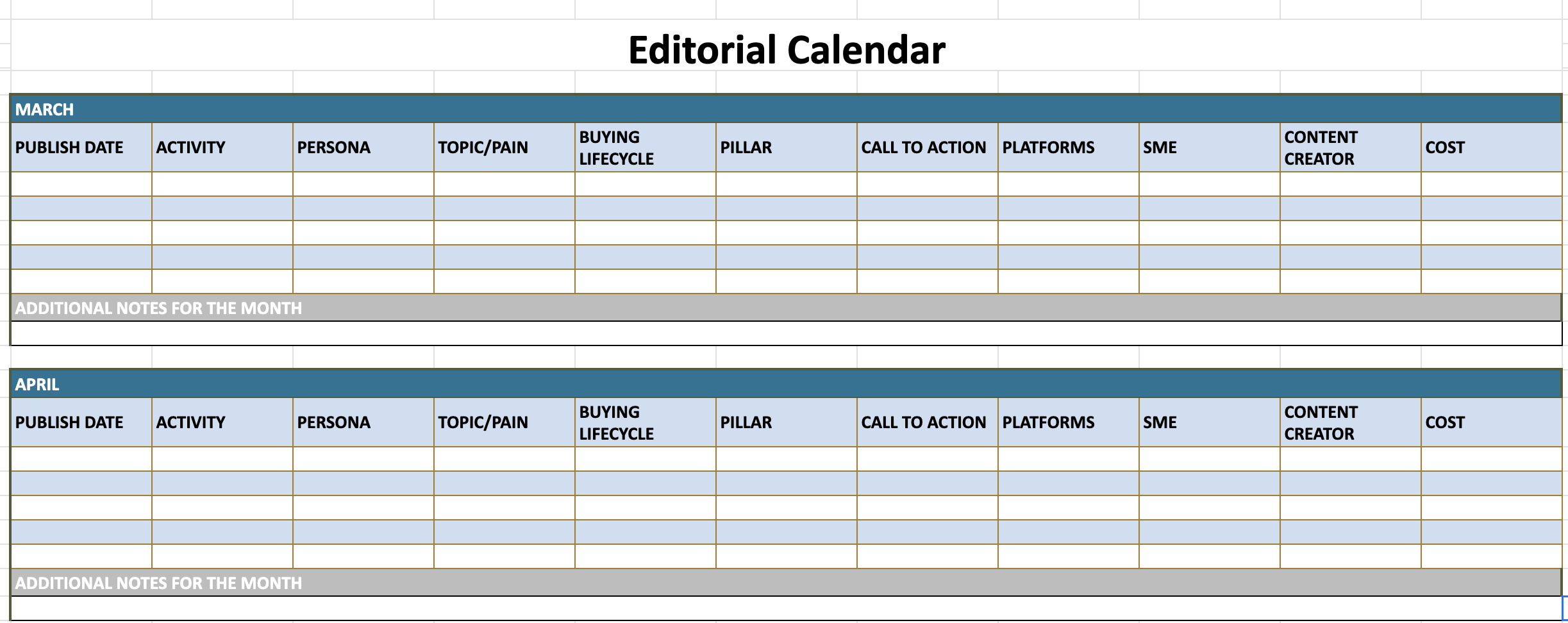
Once priorities are clear, translate them into a working editorial calendar.
This creates sequencing and accountability, especially important when aligning to market maturity shifts.
You can download the full set of content templates here.
Modern Content Types (A Quick Trigger List)
As you build your plan, it’s helpful to sanity-check your formats.
Are you only producing blogs and whitepapers?
Or are you leveraging:
Interactive demos
Benchmark reports
Short-form video
Champion enablement decks
ROI one-pagers
Community-driven content
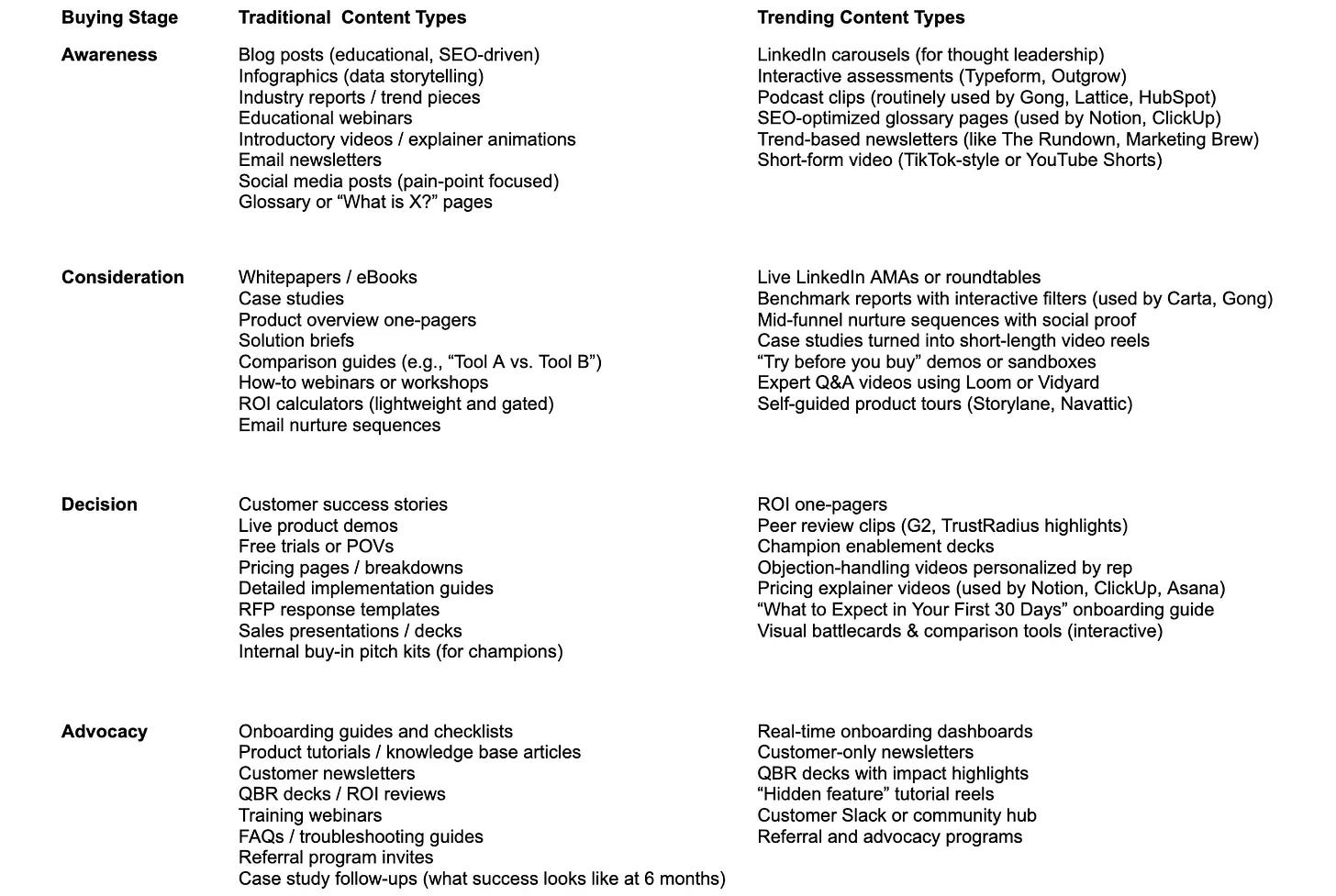
Shannon shared the following reference list she uses trigger new ideas. This overlaps with last week’s post, but it’s super useful when you’re actively planning.
Match the Journey to the Market
Too many teams build lots of assets, ship campaigns, check the boxes…
But they don’t have visibility into their coverage across buying committee personas and sales stages, in this market, at this moment. With so much historic and new content being crated all the time, it becomes hard to see the forest through the trees.
There are more AI tools than ever promising to optimize content, from intent modeling to personalization to community automation. Many of them are powerful. But AI amplifies whatever structure sits beneath it. Without a clear map of personas, stages, and market maturity, it simply helps you produce more, not better.
Do you have templates or prompts to share?
Do you have any marketing templates you’re willing to share? My original inspiration for this blog was “Show me your templates.” I was sick of hearing about marketing strategy without operational examples of how it worked in practice. I’ve tried to bring that to life through this blog and collaborations. If you have a template that would help others, please comment below or hit me up on LinkedIn.
Shannon Prager is the CMO Matic, helping redefine how AI and healthcare come together, giving medical providers time back and helping care teams work smarter. She also advises high-growth startups and provides marketing and content strategy support. You can find her on LinkedIn or at sprager@leaditmarketing.com
Carilu Dietrich is a former CMO, most notably the head of marketing who took Atlassian public. She currently advises CEOs and CMOs of high-growth tech companies. Carilu helps leaders operationalize the chaos of scale, see around corners, and improve marketing and company performance.
I'll add that Fathom recordings can be a treasure trove for that question gathering phase. There are so many I've been able to pull from conversations with clients and prospects. Definitely takes the guesswork out!
Yeah, the "showing your work" was a small touch that kind of made the post. It's helpful to simply see what other people are doing.
Thanks for the inspiration!