

Have you lived this nightmare? Your engineering team has been calling an important new product “Project Falcon” for six months. Everyone loves it. It’s on the roadmap, in the JIRA tickets, on the slides. Then, two weeks before launch, it drops into marketing’s lap, and you discover it’s either taken, legally risky, or wildly off-brand.
Product naming is one of the most consequential and chronically under-resourced activities in marketing. A great name does a lot of heavy lifting: it signals what a product does, fits within your brand architecture, stands up to competitive differentiation, satisfies legal requirements, and ideally works on Google, in conversation, and in a sales pitch. Done well, it’s worth millions. Done badly, you’re rebranding at scale.
For decades, solving this properly meant hiring a naming agency. I personally worked with SB Master, who named PayPal and over 60 Apple products, on engagements for high-profile naming. Depending on the scope of the engagement, some naming projects can cost into the six-figures. That investment was worth it for a company-level name or flagship product. But you can’t run an expensive naming project every time your product team needs to ship.
Zoom’s Naming Workflow: What They Built
At a recent CMO AI club session I hosted, CMO Kimberly Storin and Head of PMM Leo Boulton walked us through how they built an AI-powered naming workflow running natively on the Zoom AI platform and what it’s already changing about how they operate. The initiative is a testament to the innovative culture that Kimberly Storin, Zoom’s CMO, has built in her marketing organization. It’s a compelling example of Zoom using its own enterprise AI product to solve a real internal marketing problem, rather than reaching for a third-party tool.
The context: Zoom ships fast: roughly 2,800 new features and products in a single year, with about 15–16% driven directly by customer feedback. At that velocity, the traditional model, involving naming consultants, multi-week review cycles, and late-stage marketing sign-off, simply doesn’t scale.
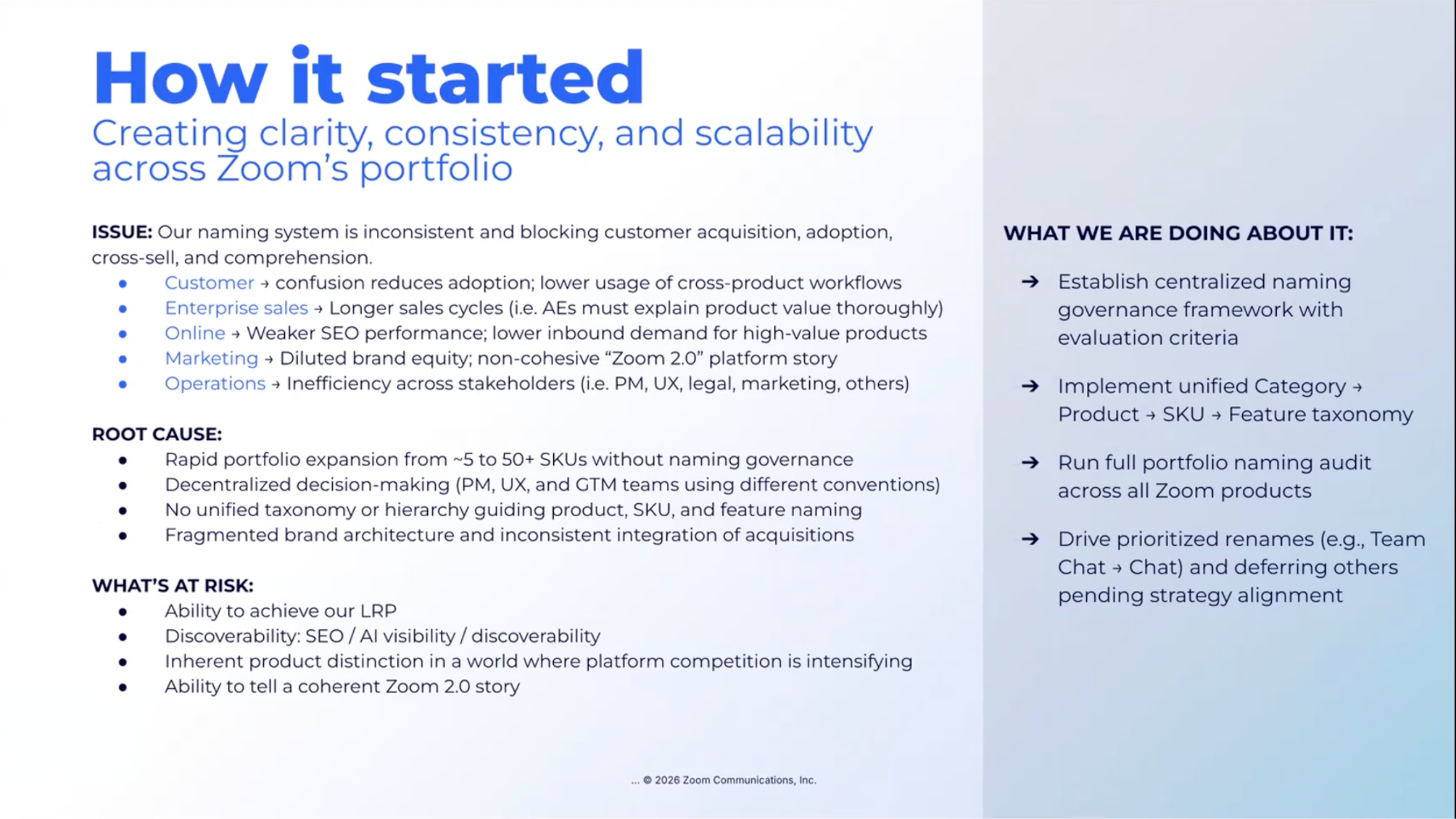
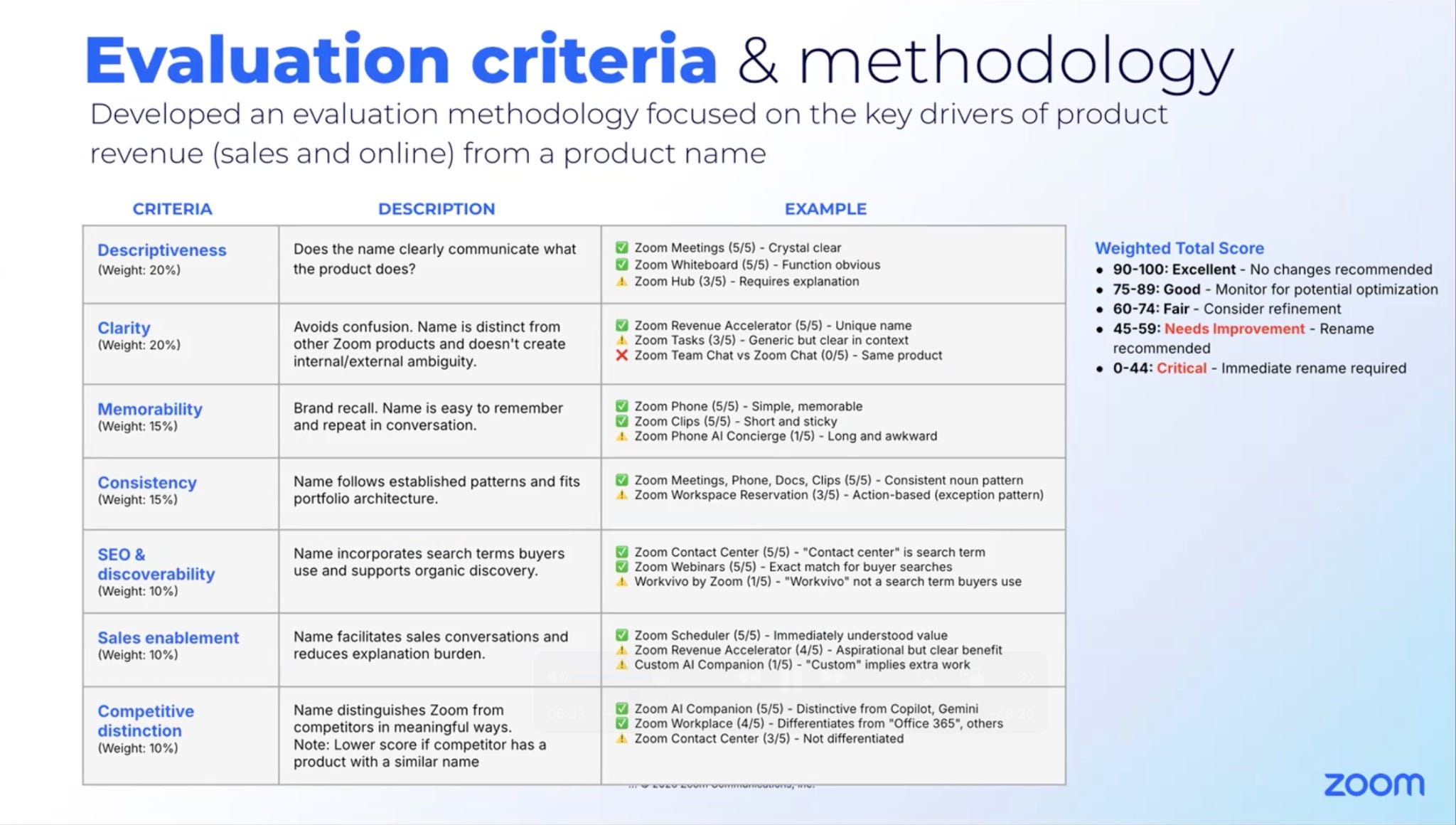
What made this even harder was that Zoom’s product portfolio had become decentralized. Names weren’t consistent. The architecture was murky. So before building anything with AI, the team did something disciplined: they audited approximately 55 of their key products to establish a baseline (!!). What makes a product name actually good? That audit produced a seven-criterion rubric that now powers the AI evaluation:
Descriptiveness — Does the name clearly communicate what the product does?
Clarity — Does it avoid confusion with other Zoom products or create internal/external ambiguity?
Memorability — Is it easy to remember and repeat in conversation?
Consistency — Does it follow established patterns and fit the portfolio architecture?
SEO & Discoverability — Does it incorporate search terms buyers actually use?
Sales Enablement — Does it facilitate sales conversations and reduce explanation burden?
Competitive Distinction — Does it differentiate Zoom meaningfully from competitors?
How It Actually Works / What That Means for You
What Leo demonstrated wasn’t a fully productized push-button agent. It was Zoom AI Companion with the right context documents loaded: the naming rubric, brand architecture guidelines, and a product messaging framework. Plus a carefully constructed reusable prompt. You can see it in action below:
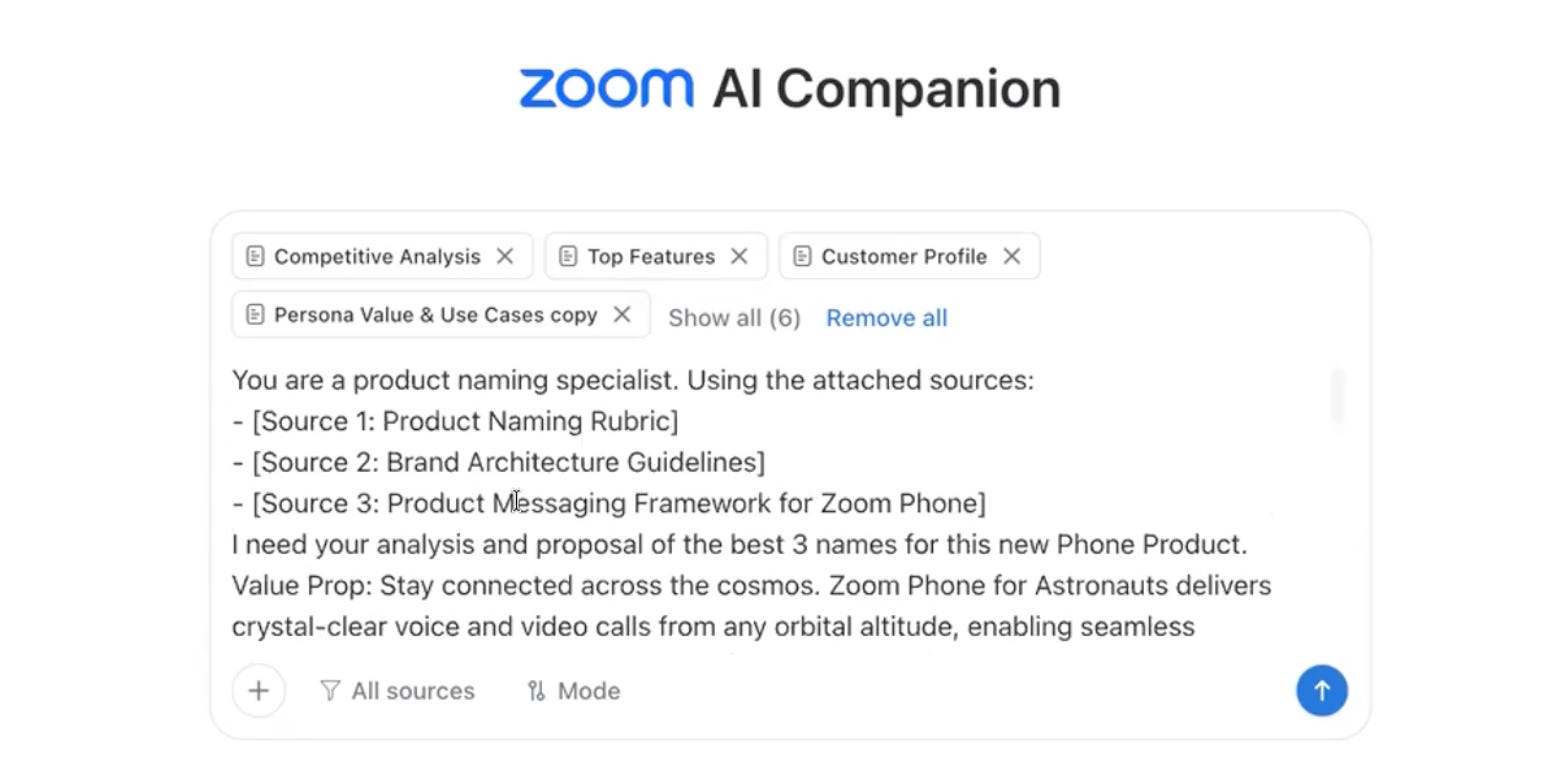
Honestly, that’s probably more empowering for most teams than a black-box tool. It means you don’t need an engineering team to build something custom. You need good source documents, a clear rubric, and a reusable prompt. The hard part is the thinking, not the tech. Zoom’s real achievement is that they did the hard upstream work of codifying their naming philosophy, building the source documents, and writing a prompt disciplined enough to produce consistent, scoreable output.
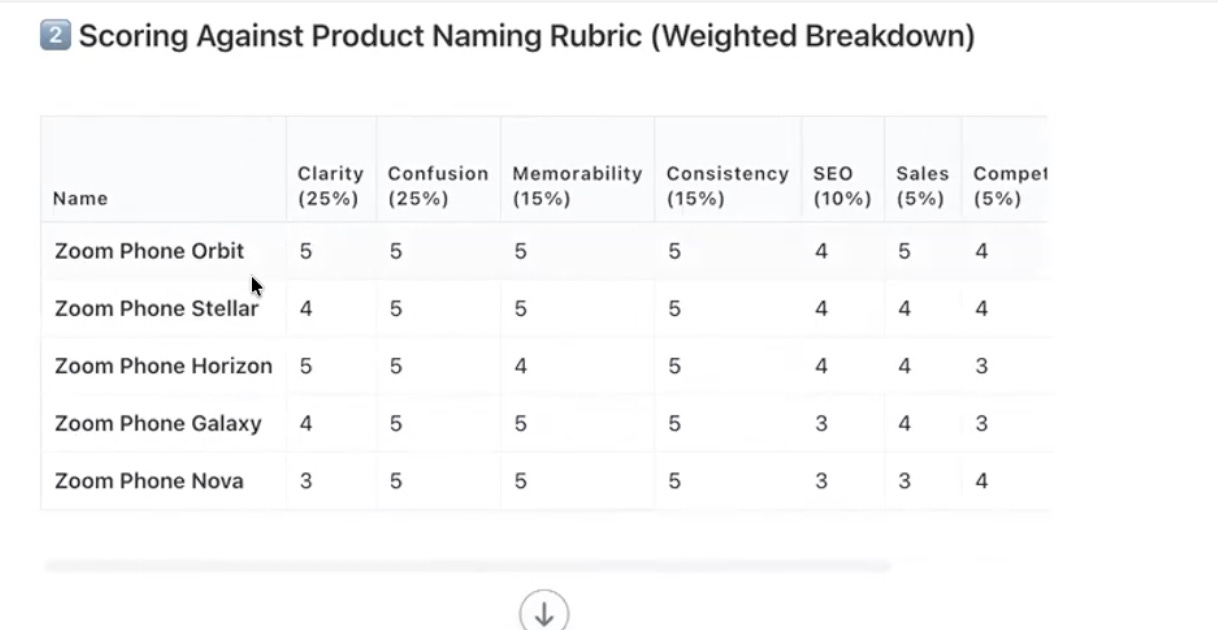
The output the AI generates ranks candidate names against the weighted rubric and recommends the top candidates for further testing:
The honest caveat: scaling this across a product organization, so that every PM runs the prompt consistently, with the right documents, at the right moment in the cycle, is the next challenge to solve. Right now, it requires someone who knows how to set it up. But the workflow itself is replicable, and the rubric is transferable. If you wanted to build something similar for your own portfolio, you could start this week. (Also Zoom itself is now already building an agent to simplify the process.)
Prompt Example
Leo was generous enough to share a prompt example for product naming. Although fictitious, the structure is the same.
You are a product naming specialist. Using the attached sources:
Brand Architecture Guidelines and Inventory
Zoom Phone Messaging Framework
Product Name Audit Rubric
Customer Profile
Top Features
Competitive Analysis
I need your analysis and proposal of the best 3 names for this new Phone Product.
Value Prop: Stay connected across the cosmos. Zoom Phone for Astronauts delivers crystal-clear voice and video calls from any orbital altitude, enabling seamless communication between mission control, crew members, and Earth—even when you’re 250 miles above the planet.
Benefit 1: Mission-critical reliability in the final frontier. Military-grade redundancy and failsafe protocols ensure zero dropped calls, because “Can you hear me now?” takes on a whole new meaning when you’re in a vacuum.
Benefit 2: Global coverage with zero dead zones. Satellite-integrated connectivity means you’re connected whether you’re docked at the ISS, performing a spacewalk, or conducting repairs on the lunar surface—no Wi-Fi password required.
Benefit 3: HD video calls that survive re-entry. Pressure-tested for extreme conditions and engineered for environments from -270°F to +300°F, Zoom Phone for Astronauts keeps your face crystal-clear even when your spacecraft can’t.Benefit 2:
Task:
Generate 5 candidate names that align with the messaging framework’s positioning
Score each name against the Product Naming Rubric, showing the weighted score breakdown
Flag any names that violate Brand Architecture Guidelines and explain why
Recommend your top 5 names for consumer testing, ranked by weighted score
For each finalist, provide: Rationale for the score; How it reinforces the product’s positioning; Potential risks or considerations
Constraints: Avoid more than 3 words
Why This Matters at Scale
The Zoom example illustrates something important about how AI is changing product marketing organizations more broadly. The team is intentionally restructuring toward a Center of Excellence (COE) model, where AI handles the repeatable, knowledge-intensive work (abstracting brand guidelines, evaluating criteria, scoring consistency), and human marketers focus on judgment, strategy, and refinement.
The insight at the core of this is right: data is the fuel. The workflow is only as good as the context you feed it. Zoom’s investment in building a structured inventory of its portfolio and codifying its naming philosophy into shareable documents is what makes the AI output actually useful. Garbage in, garbage out still applies.
One particularly powerful advantage of building on Zoom’s own AI platform: it can natively pull in meetings and meeting transcripts as context. That means customer conversations, product feedback sessions, and internal strategy discussions can all feed the naming workflow, not just static documents. Most naming tools work from briefs someone wrote after the fact; this approach can learn from the actual conversations where the product was conceived.
And here’s where it gets even more interesting: in an AI world, you could take this a step further and test candidate names against a synthetic audience of your ideal customer profiles before a single human focus group convenes. Imagine running your shortlist through an AI simulation of your target buyer (enterprise IT decision-maker, SMB founder, whatever your ICP looks like) and getting a read on resonance, clarity, and recall before you’ve spent a dollar on research. We’re not far from that being standard practice.
For CMOs and founders at high-growth companies, the lesson is straightforward: codify your naming philosophy before you automate it, audit your existing portfolio to surface the principles you’ve been applying inconsistently, and get the workflow into product teams’ hands early, before they get attached to a name. The biggest naming mistakes happen when marketing isn’t in the room early enough.
The Hard Part Nobody Talks About: Legal Clearance
Here’s what the AI workflow doesn’t solve on its own: trademark viability.
You can generate a brilliant name, score it perfectly against your brand criteria, and still find yourself unable to use it commercially because another company has a registered trademark in an adjacent class. This is where a lot of well-intentioned naming work falls apart. And it’s more common than people think.
According to a professional naming contact, only about 10% of new names in the U.S. are ever filed for trademark registration. With roughly 500,000 trademark applications filed annually with the USPTO, that implies approximately 5 million new company, product, and brand names are introduced each year, the vast majority of which never get formally searched. If you assume conservatively that 10 names are explored before one is selected for registration, that’s potentially 50 million name searches per year that need to happen (and most of them are done superficially or not at all.)
When I was CMO at Atlassian, we engaged Master-McNeil on a significant project: seriously evaluating whether to change our company name. Atlassian was hard to spell, hard to pronounce, and in the early days was frequently misspelled and mispronounced. We did a substantial naming effort, worked through a lot of candidates. But we ultimately decided to keep it. The reason? The alternatives we loved most couldn’t be readily trademarked and protected. That’s not a creative problem. That’s a legal clearance problem, and it’s more common than anyone wants to admit.
I’m a genuine SB Master fangirl. I have no financial relationship with her; I’m just an admirer of the work. She literally named PayPal. She bought naming.com at the dawn of the internet because she was already a pioneer in the field. Her naming portfolio (PayPal, Concur, Ariba, Eos, and over 60 Apple products) speaks for itself.
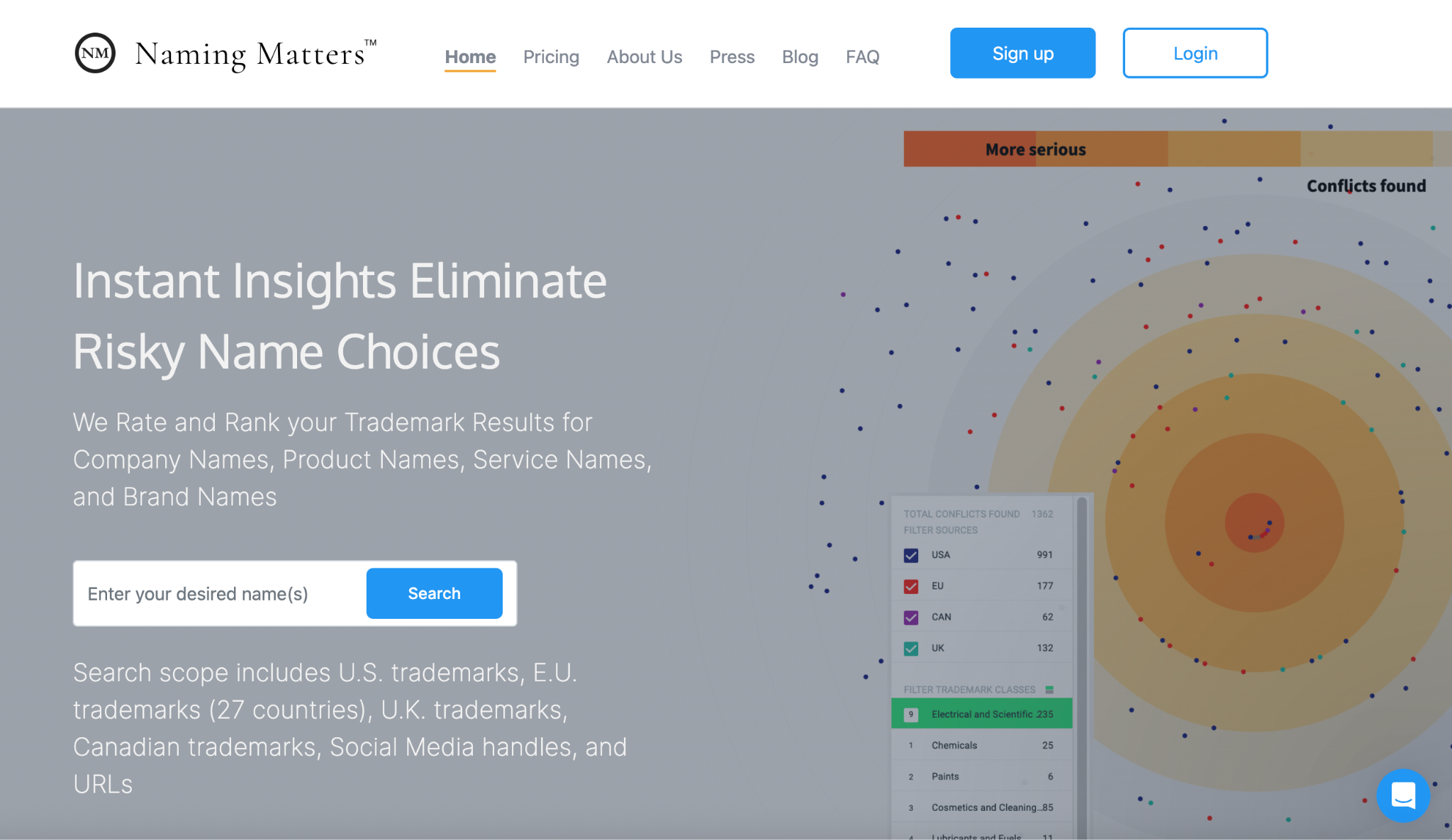
One tool you might want to consider, especially for early-stage trademark and url screening: Naming Matters, a platform SB spun out of Master-McNeil. The origin story is telling: she built it for her own internal use because checking trademark availability was too slow and expensive even for a professional naming firm. It uses natural language processing, phonetic similarity matching, and algorithmic scoring across over 14 million assessed trademarks across the U.S., E.U., U.K., and Canada, plus social handles and URLs. It abstracts decades of her naming expertise and helps people visualize the risk of different names, in the package of an affordable subscription. It won’t replace legal counsel for high-stakes decisions, but for screening a list of candidates early, before you fall in love with something you can’t use, it’s a genuinely useful tool.
The Bottom Line
Product naming has always been one of those marketing disciplines that gets treated as a soft skill until something goes wrong. Zoom is making a serious operational bet that AI can bring rigor, speed, and consistency to a process that typically lives in people’s heads, and the approach they’ve taken is replicable even without custom engineering.
For CMOs and founders building at speed: stop letting names happen to you. Build the rubric, assemble the source documents, write the prompt, and get it into the hands of product teams early. The infrastructure is simpler than you think. The discipline is the hard part.
If you’ve built a similar workflow, or tried and hit walls, I’d love to hear about it.
Carilu Dietrich is a former CMO, most notably the head of marketing who took Atlassian public. She currently advises CEOs and CMOs of high-growth tech companies. Carilu helps leaders operationalize the chaos of scale, see around corners, and improve marketing and company performance.
Great article, Carilu. Keep it coming!